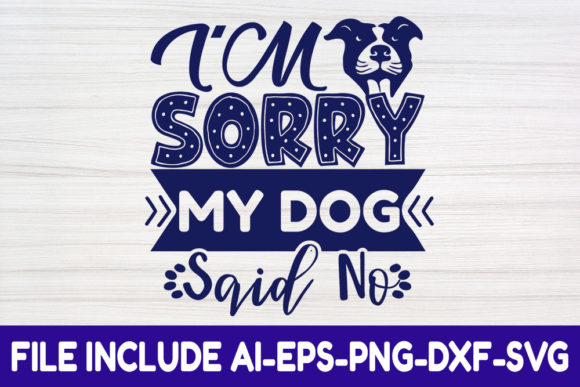
I'm Sorry My Dog Said No: A Designer's Review
As a designer who spends more time staring at stitch simulations than I do sleeping, I approach every new digital embroidery file with a mix of curiosity and skepticism. We have all seen the flood of generic pet graphics that look great on a screen but turn into a tangled mess under the needle. So, when I pulled up the Dog SVG Design, I m Sorry My Dog Said No, my first instinct wasn't to rush to the hoop, but to analyze its potential as a real-world embroidery project. This isn't just about whether the lines are clean; it is about whether this design can carry the weight of a custom order for a client who loves their stubborn pup.
First Impressions: Mood and Visual Personality
The immediate appeal of this Graphics asset lies in its humor. The phrase "I'm sorry my dog said no" captures a very specific, relatable mood that resonates with dog owners everywhere. It is sassy without being mean, playful yet firm. Visually, the layout feels balanced, likely designed with readability in mind. For an Etsy seller or craft business owner, this kind of personality is gold. It stops the scroll. However, from a technical standpoint, the transition from a vector SVG to a stitched machine embroidery design requires careful consideration of how those curves and letters will translate into thread.
The design belongs naturally in the realm of lifestyle apparel and home goods. It feels less like a formal logo and more like a conversation starter. When I imagine this stitched out, I see it working best on casual items where the texture of the fabric adds to the charm rather than detracting from it. It has the visual weight to stand alone as a chest print on a hoodie or a central feature on a tote, provided the digitizing (or the conversion process you undertake) respects the integrity of the original shapes.
Real-World Application: From Screen to Stitch
Let's walk through a realistic scenario. Imagine a customer comes to your small shop product line asking for a gift for their friend who refuses to let anyone pet their reactive rescue dog. This design is the perfect solution. I would immediately picture this as sweatshirt embroidery on a heather grey crewneck. The casual nature of the text pairs beautifully with the soft, slightly fuzzy texture of fleece or French terry.
Alternatively, consider a tote bag design for a local dog park meetup. Canvas provides a stable base that handles density well, making the letters pop. If you are selling personalized gifts, this could easily be adapted for a baby embroidery project—perhaps on a onesie for a baby growing up with a protective family dog, though scaling would be critical here. The versatility extends to holiday embroidery too; imagine this on a stocking for the "grinch" of the litter who doesn't want to share toys.
For those creating printable mockups to sell as design assets or to market finished goods, this SVG offers excellent flexibility. Since the package includes EPS and DXF formats alongside the SVG and PNG, you have the freedom to manipulate the size before sending it to your digitizing software or embroidery machine. This is crucial for maintaining crisp edges in your promotional images.
Navigating Technical Challenges and Fabric Choices
While the concept is strong, execution is everything. There are specific scenarios where you need to exercise caution with a text-heavy design like this. If you are attempting this on a curved surface like caps, the distortion can make the text unreadable unless the design is specifically column-built for hats. Standard flat files often pull awkwardly over the front panel curve.
Fabric texture is another major variable. On thin fabric or highly stretchy materials like jersey knits, you must be vigilant about stabilizer choice. Without proper backing, the "running stitch" outlines of the letters might cause puckering, ruining the finished product. Conversely, on dark fabric, you need to ensure your thread colors have enough contrast. A light thread on black cotton looks sharp, but if the design relies on subtle shading, it might get lost. Always test on scrap fabric first. This is non-negotiable for professional results.
Small details matter immensely. If the design includes tiny paws or small decorative elements near the text, check the stitch density. Too dense, and the fabric becomes stiff and board-like; too sparse, and the backing shows through. For an embroidered patch, you would want a higher density and a satin stitch border to prevent fraying, but for direct-to-garment application, a lighter touch often yields a softer hand feel that customers prefer.
Building Brand Value and Customer Trust
Using a design like Dog SVG Design, I m Sorry My Dog Said No correctly can significantly boost your brand consistency. It shows that you understand your niche audience. When a customer sees a clean, well-stitched version of this phrase on a high-quality apron or pillow cover, it reinforces trust in your handmade product. They aren't just buying a shirt; they are buying a piece of art that validates their experience as a dog owner.
However, poor execution can have the opposite effect. Blurry edges, skipped stitches, or misaligned text can make even the funniest design look amateurish. To maintain professionalism, inspect small details closely before listing items in your online store. Compare how the design looks on both light and dark backgrounds to ensure your inventory appeals to a wide range of buyers. If you are offering this as a commercial embroidery service, clarity in your product photos is key. Show close-ups of the stitching to prove the quality.
Practical Notes for the Serious Maker
Before you commit to a production run, there are several housekeeping items to address. First, verify the licensing terms. While the file formats provided (SVG, PNG, EPS, DXF) suggest versatility for both cutting machines and embroidery digitizing, you must confirm whether the license allows for unlimited commercial sales of finished physical goods. Some creators restrict the number of items you can sell, while others offer a broad commercial license.
Second, review the file structure. Since this is a graphic file, if you are using it directly on an embroidery machine, ensure you have the appropriate software to convert these vectors into a stitch file (.PES, .DST, etc.) if a pre-digitized version isn't included. If you are manually digitizing from the SVG, pay attention to the direction of the satin stitch columns to follow the natural flow of the letters.
Finally, think about the end user's care instructions. Products that need frequent washing, like custom apparel or kitchen towels, require secure locking stitches and durable threads. Advise your customers on how to care for their new item to ensure the design lasts as long as the sentiment does.
In conclusion, the Dog SVG Design, I m Sorry My Dog Said No is a potent tool for the modern maker. It bridges the gap between digital convenience and tactile craftsmanship. Whether you are decorating a boutique storefront or crafting gifts for friends, this design holds immense potential. But like any good tool, its value is determined by the skill of the hand wielding it. Treat it with respect, test it thoroughly, and it will undoubtedly become a staple in your catalog of best-selling items.